Spade vs Shovel: Which One You Actually Need
A spade cuts, a shovel scoops — and most people are digging with the wrong one. The difference, the handle types, and what to check before buying.
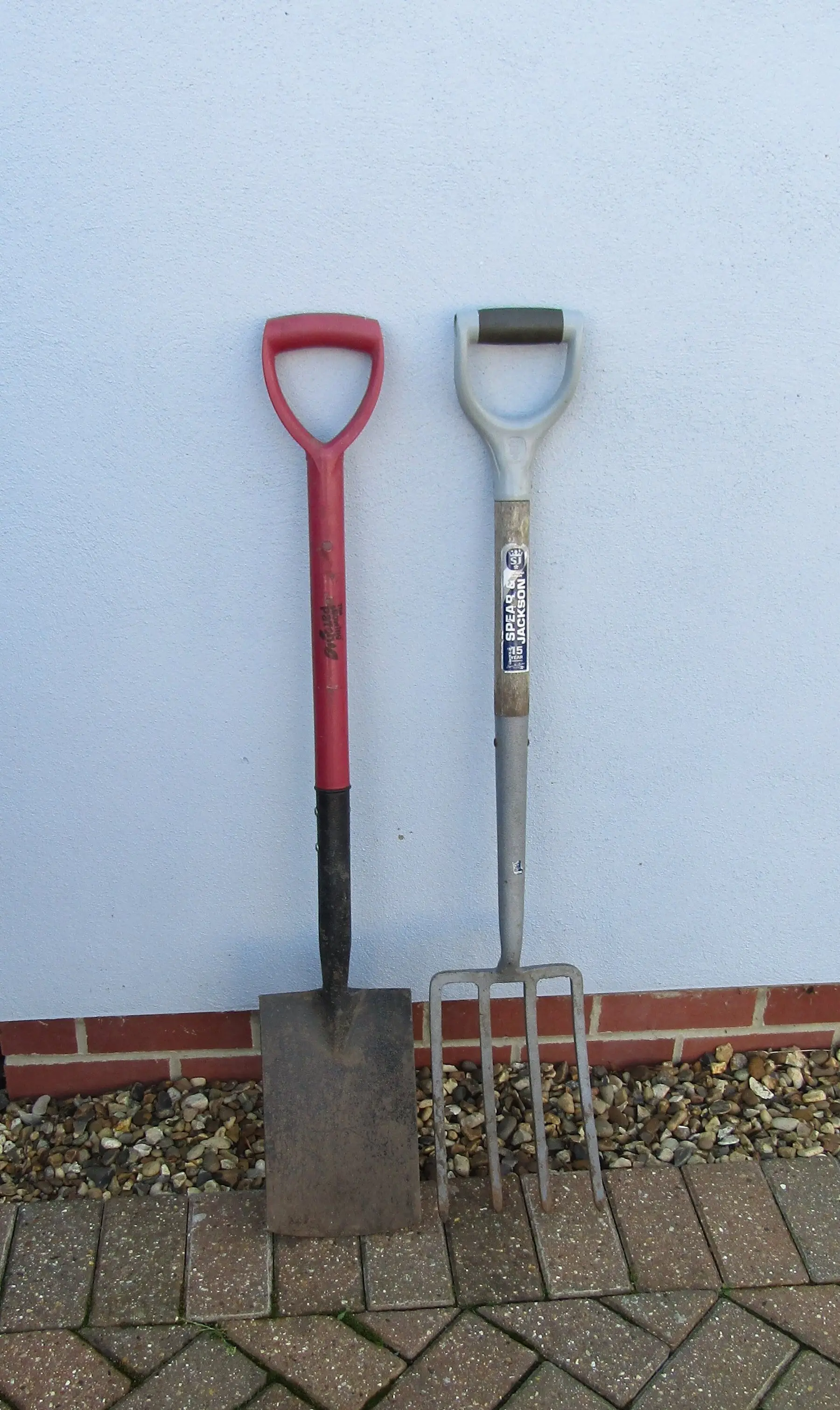

On this page
The two words get used interchangeably in shops and catalogues, which is why so many gardens contain a shovel being used badly for a spade’s job. The tools are not variations on a theme. They are built for opposite actions.
A spade cuts. A shovel scoops. Everything else follows from that.
The geometry that decides everything
Put the two side by side and the difference is in the angle between blade and handle.
A spade’s blade continues almost straight down from the shaft. That means when you step on it, your weight travels in a straight line into the cutting edge. The edge is flat and sharp, so it severs roots and slices soil rather than tearing it, and the flat back leaves a clean vertical wall.
A shovel’s blade is angled forward, away from the shaft, and dished into a scoop. That angle is wrong for driving downward — the blade wants to skip forward — but exactly right for sliding under a pile and lifting a load without spilling it.
| Spade | Shovel | |
|---|---|---|
| Blade shape | Flat, rectangular, straight edge | Dished, wider, usually pointed |
| Angle to handle | Nearly in line | Angled forward |
| Best action | Cutting down, levering | Scooping, throwing |
| Planting holes | Excellent | Poor to fair |
| Edging beds | Excellent | No |
| Lifting turf | Excellent | No |
| Dividing perennials | Excellent | No |
| Moving compost or mulch | Poor | Excellent |
| Gravel, sand, snow | Poor | Excellent |
| Mixing concrete | No | Yes |
Which to buy first
For most gardens, the spade. The jobs that come up constantly — planting a shrub, cutting a bed edge, slicing through a root, lifting a clump of turf, dividing a congested perennial — are all cutting jobs, and a shovel does all of them badly.
The shovel earns its place the moment you start moving material in quantity: a delivery of compost, a bulk bag of gravel, mulch onto beds. Trying to move a cubic yard of bark with a spade is genuinely miserable work, and that is when people finally buy the other one.
If you only ever buy one more tool
Make it a digging fork rather than a second spade. In heavy clay and in established beds a fork gets into ground a spade struggles with, lifts root crops without slicing them, and breaks up compaction without turning the soil over. Spade, fork, shovel — in that order — covers almost everything.
Choosing a good one
Head construction. Forged heads are made from a single piece of heated, hammered steel and are the most durable. Heavy-gauge stamped steel is the common mid-range and is fine for normal garden use. Thin, light, stamped blades bend at the edge the first time you lever a rock.
The head-to-handle joint. This is where cheap tools fail. A socket — where the head wraps into a cone that the handle seats inside — or a solid-forged one-piece head is far stronger than a tang, where a spike is pushed into the handle and riveted. If you can see two small rivets through a thin strap, expect it to loosen.
A tread. A folded or welded step on the top edge of the blade lets you put your boot on it and drive with your body weight instead of your arms. On a spade this matters enormously, and a spade without one will chew through boot soles.
Handle length and grip. A D-grip or T-grip on a short shaft gives control and leverage and suits close work; a long straight shaft gives more reach and leverage for moving material and is easier on the back. Standing the tool up beside you, the grip should land somewhere around hip height.
Balance and weight. Hold it as you would use it. A head-heavy tool is exhausting over an afternoon, and the heaviest tool is not the strongest — a well-forged lighter head outlasts a thick soft-steel one.
Handle material matters more than it looks
Ash and hickory handles absorb shock, can be replaced when they break, and stay comfortable in cold weather. Fibreglass is stronger and weatherproof but transmits more shock to your wrists. Painted softwood handles on the cheapest tools snap under leverage — which is exactly the load a spade is for.
Keeping the edge
A spade is a cutting tool and works far better sharp, which almost nobody does. A few passes with a mill file along the bevel of the cutting edge, once or twice a season, turns hard digging into easy digging. Keep the original angle and file in one direction.
Scrape the soil off after use — a build-up of dried clay adds weight and holds moisture against the steel — and wipe the head with an oily rag before winter storage. A decent spade looked after this way is a tool you buy once.
Common questions
What is the difference between a spade and a shovel?
Can you dig a hole with a shovel?
Do I need both a spade and a shovel?
What is a border spade?
What should I look for when buying a spade?
Backyard Weekly
Know what to plant, week by week
Free planting calendar. Join the weekly email for seasonal jobs, fixes for what is going wrong, and gear worth buying.
Set MONETIZATION.email.endpoint in src/config/site.ts to enable this form.
By subscribing you agree to our privacy policy. Grow In Backyard will never sell your address.
Keep reading
Best Raised Garden Beds: 5 Kits Worth the Money
Metal, cedar, or plastic — the material decides how long a raised bed lasts and what it costs to fill. Five kits compared, plus how to pick the right depth.
How to Lower Soil pH: What Works and How Long It Takes
Elemental sulfur is the reliable way to acidify soil, and it takes months. What to use, how much, and why coffee grounds and vinegar do not work.
Choosing a Leaf Blower: CFM, MPH, and What They Mean
Air volume moves leaves; air speed only shifts stuck ones. Why CFM matters more than MPH, how to read the noise figure, and when a rake is genuinely faster.
How to Fill a Raised Garden Bed (Without Spending a Fortune)
What to put in the bottom, the soil mix that actually works, and why hugelkultur layering is a good idea in a deep bed and a bad one in a shallow bed.