How to Grow Blackberries: Planting, Pruning and Picking
Thornless erect varieties on a two-wire trellis, pruned on the floricane-primocane cycle. Planting, feeding, and the one pruning rule that decides your crop.
.jpg)
On this page
Blackberries are the easiest soft fruit to get a crop from and the easiest to lose control of. Get two things right — a thornless erect variety and the floricane pruning cycle — and the rest is watering and picking.
Understand the cane cycle first
Everything about blackberry pruning follows from this: the roots are perennial, the canes are biennial.
- A primocane is this year’s new green cane. It grows, and normally does not fruit.
- Next year that same cane is a floricane. It flowers, fruits, and then dies.
So at any moment a healthy plant has both, and your job is to remove the spent ones and keep the right number of new ones. Primocane-fruiting varieties (Prime-Ark Freedom, Prime-Ark Traveler) break the rule by cropping on first-year canes in late summer, which gives a second harvest window and makes the pruning simpler.
Choosing a variety
| Type | Habit | Trellis | Examples |
|---|---|---|---|
| Erect | Self-supporting, suckers from roots | Helpful | Navaho, Apache, Ouachita, Arapaho |
| Semi-erect | Arching, very vigorous, high yields | Essential | Triple Crown, Chester, Black Satin |
| Trailing | Canes run 10–20 ft along the ground | Essential | Marion, Boysenberry, Obsidian |
For most backyards: thornless and erect. Navaho and Ouachita are reliable and genuinely thorn-free; Triple Crown yields more but wants real space. Trailing types have the best flavour and the least tolerance for cold — mostly a Pacific Northwest proposition.
Check your zone. Most blackberries suit zones 5–9, some only 6–9. Hardiness is the thing people skip and regret.
Planting
Early spring, as soon as the soil works, for bare-root canes. Autumn planting is fine in zone 7+.
- Full sun. Six hours minimum; eight is better and sweeter.
- Well-drained soil, pH 5.5–6.5. They will not tolerate wet feet.
- Spacing: erect 3 ft apart, semi-erect and trailing 5–6 ft, rows 8 ft apart.
- Set plants at the depth they grew, fan the roots out, water in hard.
- Cut new canes back to about 6 inches after planting. It feels wrong and it produces a much stronger root system.
Do not plant where nightshades have grown
Blackberries are susceptible to verticillium wilt, which persists in soil after tomatoes, potatoes, peppers, and eggplants. Leave at least three years, or choose another spot.
Mulch three inches deep with wood chips or straw and keep it topped up — the roots are shallow and hate both drought and competition.
The trellis
Two wires — at roughly 3 ft and 5 ft — on posts every 15–20 feet. That is the whole design.
The best version keeps this year’s primocanes on one side of the wires and last year’s fruiting floricanes on the other. Picking gets easier, airflow improves, and after harvest you can cut out one entire side without thinking about it.
Pruning, in two moves
Summer, on erect varieties: when a primocane reaches about 40 inches, cut the tip off. It stops extending and pushes out lateral branches, and laterals are where the fruit is. Untipped erect canes grow tall, flop, and fruit at the top only.
After harvest: cut every floricane that has fruited to the ground. It is dead already, and leaving it invites cane blight. Then select four to six of the strongest new canes per plant, tie them in, and remove the rest at the base.
Late winter: shorten the side branches to 12–18 inches and take out anything damaged or thin.
On primocane-fruiting varieties you can simply mow everything to the ground in winter and take a single late-summer crop — much less work, at the cost of the early harvest.
Water, feeding and picking
Water is the thing that decides berry size: 1–2 inches a week, and more while the fruit is swelling. Drip is much better than overhead, which spreads fruit rot.
Feed once in early spring with a balanced fertilizer, and again lightly after harvest. Excess nitrogen gives you enormous canes and mediocre fruit.
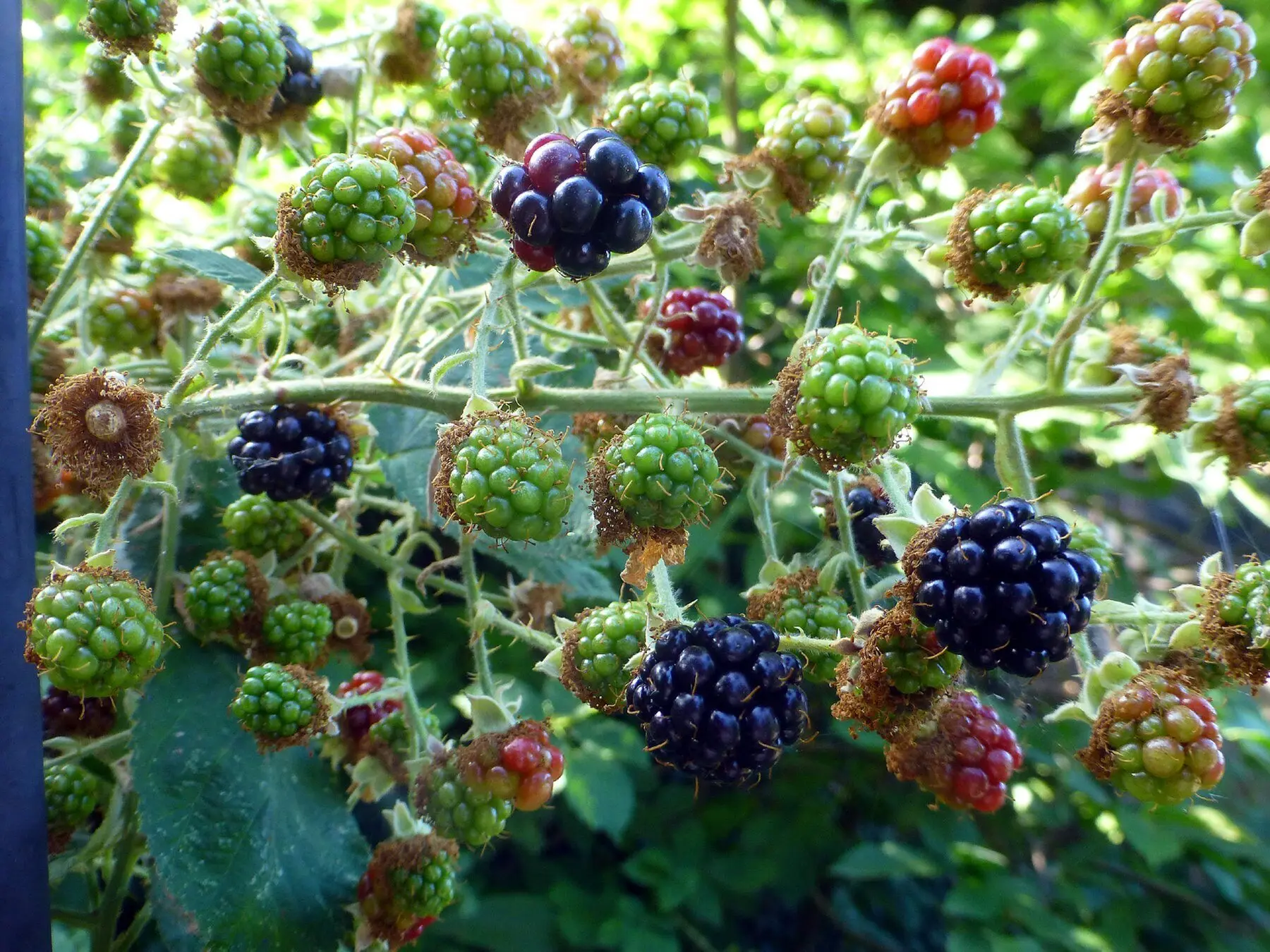
Pick when the berry is fully black, dull rather than shiny, and pulls away with no resistance. A blackberry that needs a tug is not ready, and unlike a raspberry it will not ripen further after picking. Harvest every two or three days in the peak, in the morning, and refrigerate immediately — they last two or three days fresh and freeze extremely well spread on a tray first.
Keeping them contained
Erect varieties sucker from the roots and will march out into the lawn. Pull suckers rather than cutting them, as soon as they show, and mow the strip either side of the row.
In a small garden, a root barrier sunk 18 inches around the bed contains them, and a large container (20 gallons plus) works well for a single erect plant. Never let escaped canes fruit and drop berries — that is how a blackberry patch becomes a blackberry problem.
Common questions
When should you plant blackberries?
How long until blackberries fruit?
How do you prune blackberries?
Do blackberries need a trellis?
Why are my blackberries small and seedy?
How do you stop blackberries spreading everywhere?
Backyard Weekly
Know what to plant, week by week
Free planting calendar. Join the weekly email for seasonal jobs, fixes for what is going wrong, and gear worth buying.
Set MONETIZATION.email.endpoint in src/config/site.ts to enable this form.
By subscribing you agree to our privacy policy. Grow In Backyard will never sell your address.
Keep reading
How to Grow Blueberries: It Is All About Soil pH
Blueberries need pH 4.5 to 5.5 and will slowly starve above it. Getting the soil right, why you want two varieties, and the pruning that keeps fruit coming.
How to Grow Strawberries (And Get Fruit the First Year)
Strawberries are easy to grow and easy to get wrong. Which of the three types to plant, why you pinch the first flowers, and how to keep a bed producing.
How to Grow Grapes: Prune Hard, and Prune in Winter
Grapes fruit on shoots from last year's wood, so timid pruning gives a huge vine and no crop. The two training systems, and why summer pruning is separate.
Can You Eat Crab Apples? Yes, and They Make Better Jelly
Crab apples are edible, sour, and unusually high in pectin — which is exactly why they set jelly no other fruit will. The one part to avoid, and which trees to pick.