How to Harvest Basil So the Plant Gets Bushier
Cut above a leaf pair, never strip the bottom leaves, and pinch the flowers. The harvesting method that doubles the size of a basil plant instead of ending it.

On this page
Most basil plants are killed by the way they are harvested, not by pests or weather. Picking leaves off the bottom of the stem produces a bare stalk with a pom-pom on top; cutting correctly at the top turns one plant into something twice the size.
The rule is short: cut above a leaf pair, always from the top, and never let it flower.
Why the cut point matters
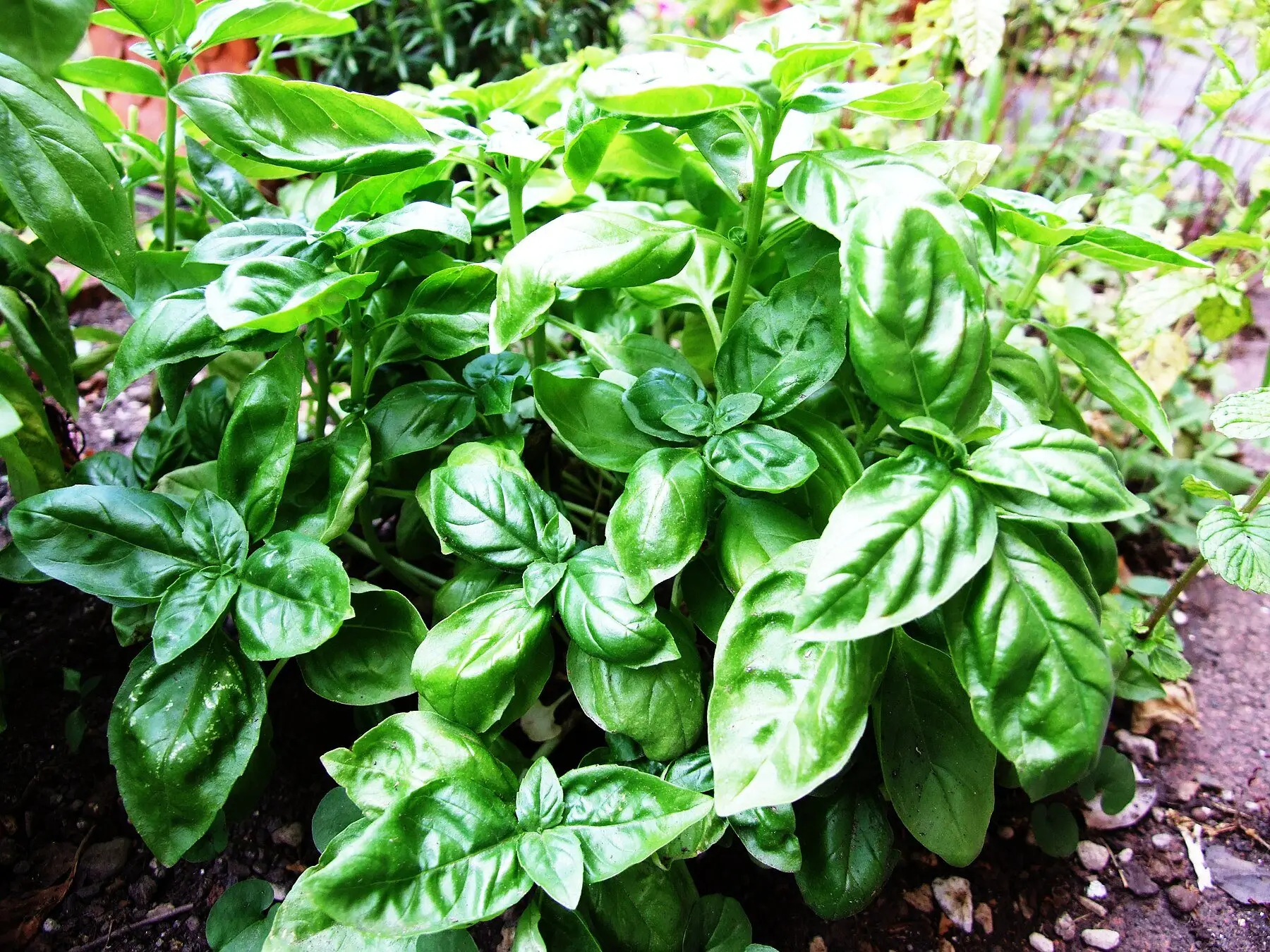
Basil grows in opposite pairs, and at every leaf pair — every node — sit two dormant buds. While the growing tip is intact, it suppresses them; this is apical dominance. Remove the tip and both buds release at once.
So a cut just above a node gives you two stems where there was one. Do that three or four times through a season and a single plant becomes a small bush.
Cut in the middle of a bare stem instead, with no node beneath the cut, and there is nothing to release — the stub simply dies back to the node below. Same for taking a lower leaf: you have removed a solar panel and triggered no branching at all.
What to look for before you cut
Trace a stem down from the tip until you find a leaf pair with two miniature leaves already visible in the joints. Those are the buds. Cut a quarter inch above them.
When to start, and how much to take
Leave a young plant alone until it is around six inches tall with three or four leaf pairs. Harvesting a seedling stunts it for weeks.
After that, take up to a third at a time, every one to two weeks. Frequent moderate cuts beat occasional heavy ones — the branch count compounds, and a plant harvested this way will out-produce an untouched one several times over across a summer.
Morning is the right time, after dew has dried and before the day heats up. Essential oil content peaks then, which is why morning basil smells stronger.
Stop it flowering
A flower spike at a growing tip is the plant announcing it is done making leaves. Pinch it out with the leaf pair below it the day you notice it.
Miss a few and the leaves turn bitter and thin. Cut the plant back by half, to a strong leaf pair, and it will usually push a new flush of milder growth. Basil is an annual though — it wins eventually, and late in the season letting a plant flower is fine. The bees get it, and you can save seed.
The end of the season
Basil is tropical and collapses at around 40°F, days before anything resembling a frost. Watch the forecast: when a night in the low forties is coming, cut everything at the base.
That is your pesto day. Blend with oil, freeze in portions, and you are eating summer basil in January.
Cuttings root easily in a glass of water — a tip taken in late summer will happily be a windowsill plant through the winter, though it will never be as vigorous as one grown outdoors.
Step by step
- Time
- PT5M
- Cost
- $0
- You need
- An established basil plant, at least 6 inches tall
- Tools
- Clean scissors or your fingers
Wait until the plant has six to eight true leaves
Harvesting a seedling stunts it. Let the plant reach about six inches with three or four pairs of leaves before the first cut.
Find a leaf pair with small shoots at its base
Look down a stem from the tip and find a node where two tiny leaves are emerging in the joints. That node is where the two new branches will come from.
Cut just above that pair
Take the stem about a quarter inch above the node, removing everything above it. Cutting below the node, or cutting mid-stem where there is no node, leaves a stub that dies back.
Take from the top, never the bottom
Picking individual lower leaves is the commonest mistake — it removes the plant's working solar panels and triggers no branching at all. Always harvest the growing tips.
Pinch flower buds the moment you see them
As soon as a flower spike appears at a tip, pinch it off with the top leaf pair. Once basil flowers it redirects everything into seed and the leaves turn bitter and sparse.
Repeat every one to two weeks
Each cut doubles the number of growing tips. Regular light harvesting through the season produces far more basil than leaving the plant alone and stripping it once.
Take the whole plant before the first frost
Basil dies at around 40F, well before an actual freeze. Cut everything remaining at the base and preserve it rather than losing it overnight.
Common questions
Where exactly do you cut basil?
Should you pick basil leaves from the top or the bottom?
How often can you harvest basil?
What happens if basil flowers?
Can you harvest basil after it flowers?
What is the best way to preserve a basil harvest?
Backyard Weekly
Know what to plant, week by week
Free planting calendar. Join the weekly email for seasonal jobs, fixes for what is going wrong, and gear worth buying.
Set MONETIZATION.email.endpoint in src/config/site.ts to enable this form.
By subscribing you agree to our privacy policy. Grow In Backyard will never sell your address.
Keep reading
How to Grow Basil: Pinch It Early, Pinch It Often
Basil is easy to grow and easy to lose to one mistake — letting it flower. How to sow it, where to put it, and the pinching routine that keeps it producing.
How to Store Cilantro So It Lasts More Than Two Days
Cilantro wilts fast because it is mostly water with thin leaves. The jar method, what actually freezes well, and why drying it is largely a waste.
How to Grow Mint Without It Taking Over the Garden
Mint spreads by runners just under the surface and will colonise a bed in two seasons. Containment that actually works, and the pruning that keeps leaves tender.
How to Grow Cilantro Without It Bolting in Three Weeks
Cilantro bolts on heat and day length and nothing stops it, so the answer is succession sowing. Direct sowing, why it hates transplanting, and the seed crop.