Lawn Sweeper: What It Does That a Rake and Mower Can't
A sweeper brushes debris into a hopper as you tow or push it. Where it beats bagging leaves, where it fails, and the brush height that decides whether it works.

On this page
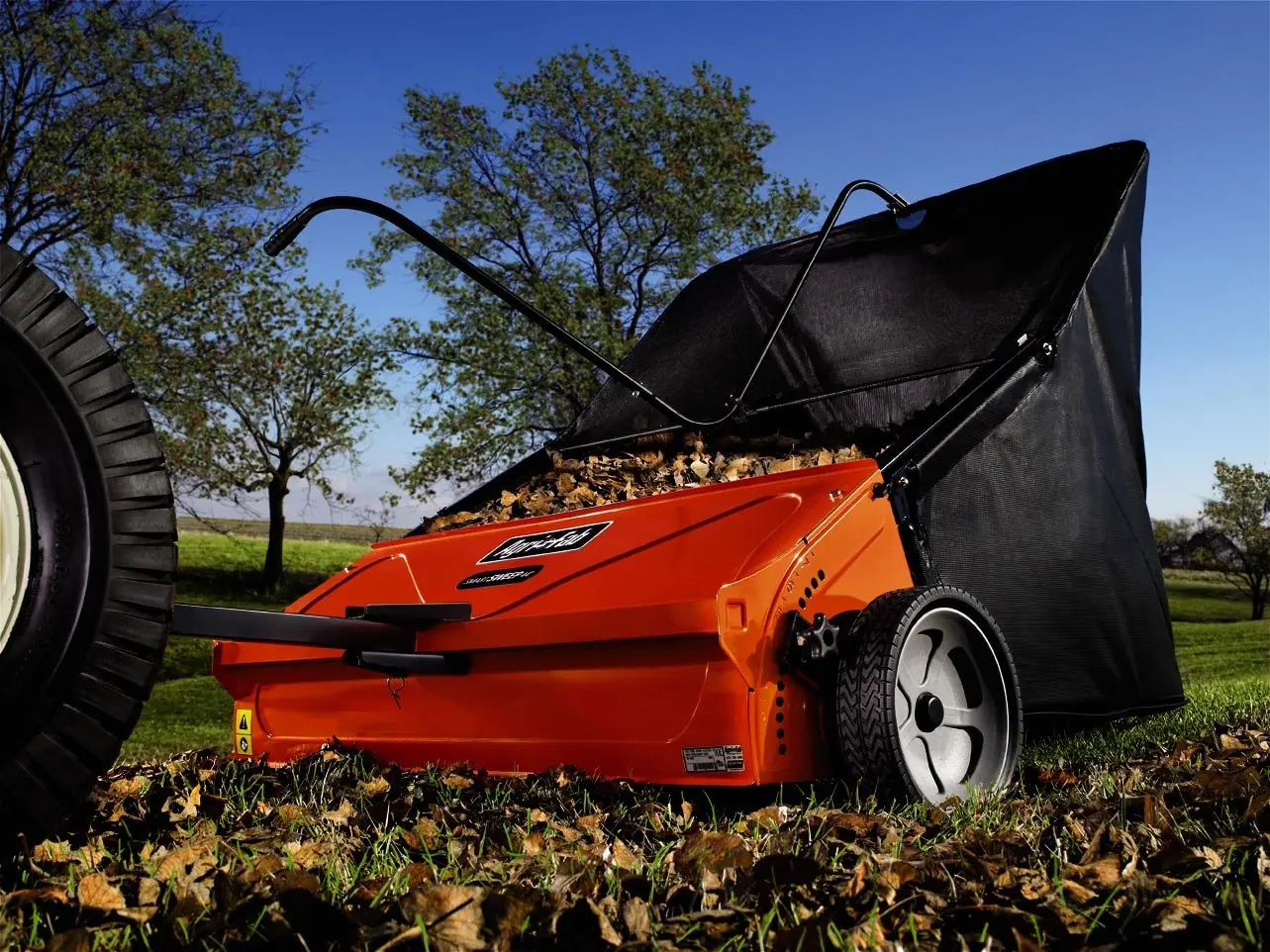
A lawn sweeper is a simple thing: brushes geared to the wheels, flicking debris up into a bag behind. No engine, no suction, nothing to service.
It is genuinely excellent at one job — clearing dry leaves and pine needles from a large lawn — and noticeably poor at several others people buy it for.
What it actually is
The brushes sit under a frame and are geared to the wheels. Roll the sweeper forward and they spin backward, throwing debris over the top of the brush housing into a fabric hopper.
That is the whole mechanism, and two consequences follow:
- Speed matters. Too slow and the brushes do not spin fast enough to throw debris over the lip. Most tow-behind sweepers want 3 to 5 mph — a brisk walking-to-slow-driving pace.
- Nothing is sucked. Anything the brushes cannot flick, they simply push along the ground.
Where it beats the alternatives
| Job | Sweeper | Rake | Blower | Mower bagger |
|---|---|---|---|---|
| Dry leaves, large lawn | Best | Slow | Good, then you still collect | Fills constantly |
| Pine needles | Best | Nearly useless | Poor — they lie flat | Fair |
| Wet leaves | Poor | Good | Poor | Fair |
| Grass clippings | Fair | Poor | Poor | Best |
| Small twigs | Good | Fair | Poor | Poor |
| Acorns, nuts, cones | Hit and miss | Good | No | No |
| Beds and gravel | No | Yes | Yes | No |
| Tight corners | Poor | Best | Good | Fair |
The comparison that matters most is against a mower bagger. A bagger holds a few cubic feet and fills in minutes when leaves are down, so you spend the afternoon walking to the compost heap. A tow-behind sweeper holds 12 to 26 cubic feet and does not require you to mow at all — which matters in late autumn when the grass has stopped growing but the leaves have not stopped falling.
The limitation nobody mentions until after
Wet leaves. They stick to the turf and to each other, and the brushes skid over them or roll them into sausages. A sweeper is a dry-weather tool.
In a wet autumn that means waiting for a dry, breezy day, or blowing the leaves into rows first and letting them dry before sweeping. It does not replace a rake for the soggy corners.
Heavy debris. Acorns, conkers, cones and thick twigs are often too heavy to be flicked up over the brush housing. Some go in; many get pushed along.
Thick, matted layers. A sweeper takes a layer at a time. Six inches of leaf fall needs several passes, and expecting one pass to clear it is how people conclude the machine is useless.
Brush height is not a fit-and-forget setting
Most complaints about sweepers picking up nothing are height problems. The brush tips should just touch the top of the grass — no more. Too high, and they wave over the leaves. Too low, and they dig into the turf, fill the hopper with dirt and thatch, and wear the bristles out in a season. Reset it whenever you change mowing height, and check it again on a different part of the lawn.
Push or tow-behind
Push sweepers — around 21 to 26 inches wide, hoppers of 5 to 8 cubic feet. Cheap, compact, no tractor required. The catch is effort: it is all on you, and a full hopper is heavy. Sensible up to about a quarter acre.
Tow-behind sweepers — 38 to 50 inches wide, hoppers of 12 to 26 cubic feet. Much faster, much bigger, and no effort beyond driving. They need a ride-on or lawn tractor with a hitch, and they need somewhere to live in the winter, because they are large.
Half an acre is roughly where the tow-behind starts to be the obvious answer.
Getting good results
- Mow first, if the grass is long. Long grass swallows leaves and blocks the brushes.
- Keep a steady, brisk pace. Slowing down reduces pick-up rather than improving it.
- Overlap passes by a few inches — the outer edges of the brush do less work.
- Empty the hopper before it is packed. A full bag stops debris entering and it all gets pushed along instead.
- Store it dry, and out of sunlight if you can. UV is what kills the fabric hopper.
What to do with what you collect
Do not bin it. Leaves are the single most useful free material a garden produces.
Leaf mould — leaves stacked in a wire cage or a bin bag with a few holes, left for a year or two, break down into a superb soil conditioner. It is slow because leaves rot by fungal action rather than bacterial, which is also why they are worth separating from the compost heap.
Compost — mix them in as the brown, carbon-rich component alongside green material like grass clippings. A sweeper full of shredded leaves and clippings mixed together is close to an ideal ratio already.
Mulch — a few inches over beds through winter, where they suppress weeds and are pulled down by worms. Related: worm castings.
Common questions
How does a lawn sweeper work?
Is a lawn sweeper better than a bagger on the mower?
Does a lawn sweeper work on wet leaves?
What brush height should you set a lawn sweeper to?
Do lawn sweepers pick up acorns and pine needles?
Is a push or tow-behind lawn sweeper better?
Backyard Weekly
Know what to plant, week by week
Free planting calendar. Join the weekly email for seasonal jobs, fixes for what is going wrong, and gear worth buying.
Set MONETIZATION.email.endpoint in src/config/site.ts to enable this form.
By subscribing you agree to our privacy policy. Grow In Backyard will never sell your address.
Keep reading
Push Mower vs Self-Propelled vs Reel: Which to Buy
Lawn size and slope decide this, not budget. What each type actually costs you in effort, and why a reel mower cuts better but suits almost nobody's lawn.
Coffee Grounds in the Garden: What They Actually Do
Used coffee grounds are not acidic, do not repel slugs, and should never be spread thickly. What they are genuinely good for, and how to use them.
What Are Worm Castings, and Are They Worth Buying?
Worm castings are worm manure — a mild fertiliser whose real value is microbial, not nutritional. What the numbers mean and how much you actually need.
How to Plant Grass Seed So It Actually Comes Up
Seed fails from poor contact and a surface that dried out once, not from bad seed. Soil prep, sowing rates, and the watering routine that carries it to germination.